ASK THE PSYCHOLOGIST ISSUE 69: IS THERE A REASONABLE SOLUTION TO THE HOMELESS PROBLEM
Is the media reporting the government’s lack of a solution for the homeless problem?
What I have seen that worked in the past for dealing with the homeless problem can be effective now.
When I moved to California in 1969, I worked extensively with the homeless at Mendocino State Hospital in Ukiah, having another office in Santa Rosa, California. Most of the people I saw were originally from San Francisco (which is about 60 miles south of Santa Rosa and 120 south of Ukiah)
who were picked up by the police in San Francisco and transported to Mendocino State Hospital. Most patients from San Francisco who
were taken to the hospital had a diagnosis of alcoholism or illegal substance abuse, with many being homeless. At that time, many of these people were called vagrants—a person without a settled home or regular work, who wandered the streets, going from place to place and living by begging, stealing, drug dealing, etc. This population now, to be politically correct, are referred to as homeless.
In San Francisco during this period, it was illegal to be a vagrant on the streets, since most of these homeless had physical, mental, emotional, and
substance abuse problems. The police issued a 5250 or 14-day hold to get the person the help they needed. The determination at that time was that the
person was a danger to themself or others. Additional holds occurred, once the first
14-day hold expired, if the patient continued to meet criteria for involuntary hospitalization, thus the treatment team may extend the hold. When this additional 14-day hold was to be placed, there would be a new hearing that would take place.
Many lives were saved and lives dramatically improved, by the above-mentioned procedure I personally observed.
What occurred when the person was taken to Mendocino State Hospital was as follows:
1. A diagnosis was made so the person could be placed in an appropriate treatment program.
2. All physical problems were immediately treated.
3. Appropriate food, clothing, and living accommodations were provided (basic psychological needs met).
Appropriate therapy programs (to meet the four higher level psychological needs) were instituted, with a large variety of treatment modalities from Alcoholics Anonymous-type programs, behavior
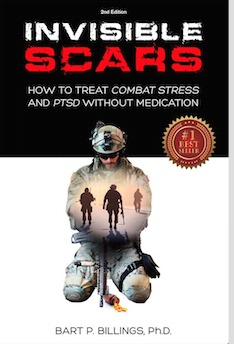
modification, transactional analysis, reality therapy, Native American, etc. Limited use of black box warning, brain-altering psychiatric drugs was advised, since they would cloud a patient’s judgement as well as having detrimental side effects ( See the text Invisible Scars for more on adverse reactions to psychiatric medications and use of integrative treatment).
Peer groups worked effectively if led by a skilled trained therapist (ex-patients were hired,
but were not effective, since they would be more or less, a paid patient.
For an ex-patient to be hired, it was recommended that they leave the hospital and get a regular non-mental health job and take college classes
in this field).
Each of the above therapy programs had their own separate building and patients took pride in what program they were living in. This was readily
observable when each program would send representatives to the weekly general population
group therapy meeting, to determine who was ready to be referred to the California Dept. of Rehabilitation – DOR (Their offices and counselors located within hospital grounds, in their own building), for acceptance into their
program for training, job placement, on-the-job training, or preliminary or advanced education,
including college. All these services, plus more, were totally free, and patients worked hard to be accepted into the privileged DOR program (It was not a rights program). In preparation for their applying for entry into the DOR program, they would do research, while in the hospital, regarding occupations they felt would be desirable to ask support to be trained for.
When a patient became a client of DOR, they would make plans to leave the hospital and live in a halfway house with other patients. There would
be group therapy sessions in the evenings, run by county social workers and their rehabilitation counselor.
The living facility was paid for by the patients, since they received a social security disability check each month.
In 1974, I personally did a research project, showing that therapy and vocational training, being done simultaneously, was more effective than either alone. This finding validated itself, when most patients, eventually left the halfway house, with a job
or moved into a college program, where they became independent, living on their own, in a private apartment or home.
A book I published in 1974, that explained the success of the program discussed above was:
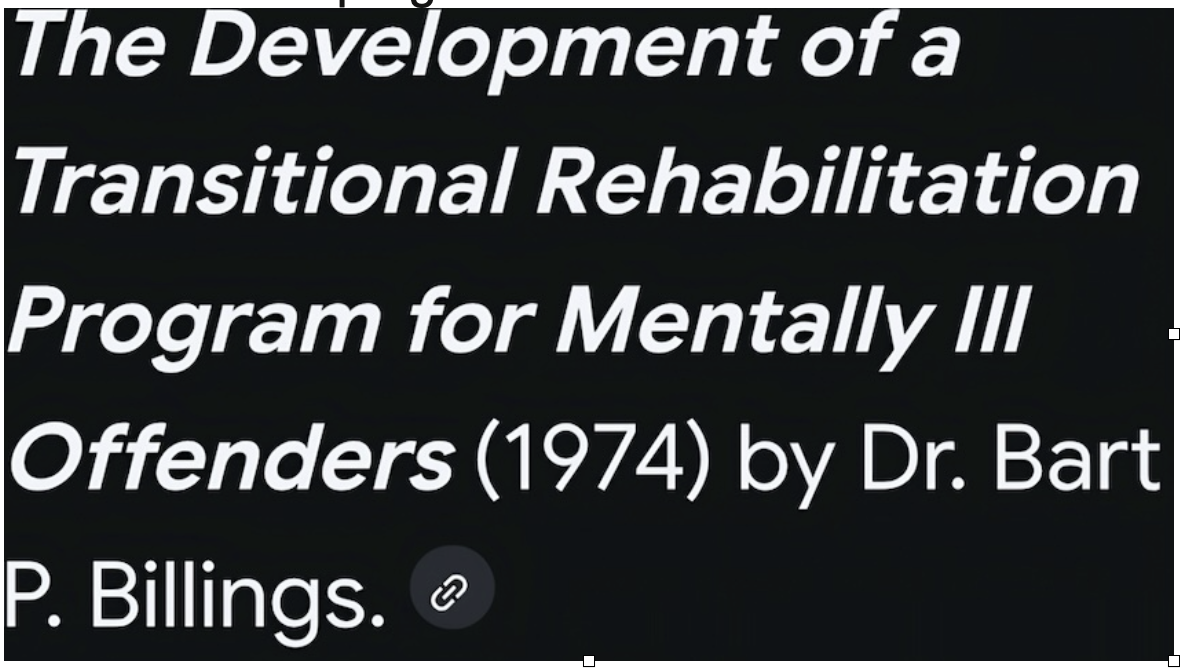
The book was published by Free Person Press, which was a small independent publisher, in the San Francisco Bay Area during the 1970s. The book was widely distributed by DOR to all its offices in the Northern Region of California, by its Regional Administrator, Bob Hawkins. The National Rehabilitation Association awarded me the Elkins Award ( Counselor of The Year in California) for my work in this area.
These programs ended in the 1970’s, when politicians decided that people in mental hospitals
had the legal rights to live in the community, even if they were not physically or mentally ready to do so.
By closing state-run mental hospitals, the states projected they would save much money, which turned out to be a fallacy and inhumane.
The solution, now, would be to establish facilities, like the state hospitals of the past , and provide funding for the homeless population, which has
been described above. There are many vacant, abandoned military facilities that could be remodeled and staffed with people who can provide the above
services. Let’s not forget that each state has a Vocational Rehabilitation Agency,
mostly funded by the government, to work with the disabled community, as it did in the 60s and 70s and back to the 1920s when the National rehabilitation Act was passed (Smith-Fess Act).
Also, let’s not forget that there were many people from WWI living on the streets after the war, when the Smith Fess Act was passed by congress in 1920.
Today, it is called the National Vocational Rehabilitation Act (NVRA), with funds for every state to work with the disabled populations, which most of
today’s homeless qualify for.
Laws need to be changed now (vagrancy laws), to help get the homeless into treatment and vocational programs, and State and Federal agencies need to
do their jobs, as they were directed to do in the 1920s, since the NVRA gets re-certified on a regular basis and exists today.
In the early 1990s, I actually wrote the position paper for a congressman
(chairman of the committee) to re-certify the NVRA at that time. Then, one of my major goals was to establish higher national educational levels for Rehabilitation Counselors working for the NVRA agencies. Currently, we have more highly educated counselors
working in all state agencies. But the problem is that the people running federal and state governments aren’t utilizing this agency as it was used with success in the past.
As a famous management expert, Dr. W. Edwards Deming, (named an ASQ Honorary member in 1970 for his role as adviser, consultant, author, and teacher to some of the most influential businessmen, corporations, and scientific pioneers of quality control, is the most widely known proponent of statistical quality control) once said, “Ninety-four percent of any organization’s problem is management.”
If the media in the US was doing its job now, which in a democracy, is to honestly, without bias, report on government shortfalls, we would all know
what humanely needs to be done for the homeless on our streets. The homeless problem in the United States would disappear within a relatively short period of time (2 to 5 years), if the procedures above are followed. Expenditures would not be much different, than what is now being spent on a totally failed program, that local and national governments are spending, which in fact, is keeping people homeless…
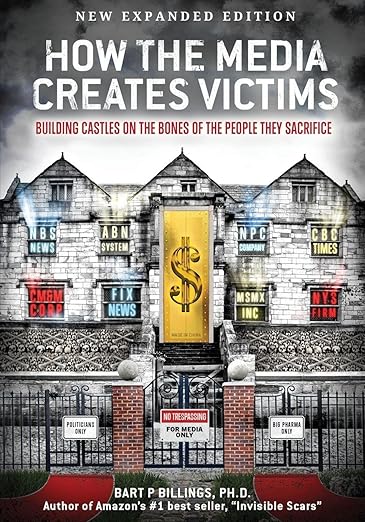
Most of this information can be found in my book, How the Media Creates Victims
P. Billings, Ph.D.
COL SCNG-SC, Military Medical Directorate (Ret.)
Functioned as: Licensed Clinical Psychologist CA PSY 7656
Licensed Marriage, Family Therapist CA LMFT 4888
-Director/Founder International Military & Civilian Combat Stress Conference
-Initial Enlisted Ranks and Retired as Medical Service Corps Officer with a total of 34 years in US Army
-Recipient of the 2014 Human Rights Award from Citizens Commission on Human Rights International & The University Of Scranton “Frank O’Hara Award” in 2016.
bartbillings@yahoo.com
http://bartpbillings.com (“How The Media Creates Victims…,Invisible Scars” & “Unhealthy Eating …” Books Website)
www.combatstress.bizhosting.com (Combat Stress Conference website)
www.youtube.com/watch?v=F02HElsg8uI
Cell 760 500-5040
Ph 760 438-2788
MOST CURRENT BOOK
https://www.amazon.com/How-Media-Creates-Victims-sacrifice/dp/1957832835
Customer reviews
4.7 out of 5 stars
–“Dr. Billings has beautifully consolidated and researched the major issues that our country faces today.”–“purchased 50 COPIES of the book to give out as gifts!”–“book proves that Google = Goebbels, Meta = Marx, and Media = Mayhem”
Some Amazon 5 Star
Recent Customer Reviews
– This Book Saved My Life.
– I am sure that this book will save lives.
– 25 pages into Invisible Scars, I knew that it was the second most important book I would ever read…after the Bible. — David T. Ossian, Asst. National Vice Commandant , Marine Corps League
– This book is life changing…everyone needs to read …. http://a.co/4wlhtsa Danny Jimenez
5.0 out of 5 stars I have lost 140 lbs in 3 years …
At least 70 is from this Book